
Wellbeing, Emotional Intelligence, and the Genius Zone at Work
Feb 20, 2026
by Charlette Pomme
“Well-being can be understood as how people feel and how they function, both on a personal and a social level, and how they evaluate their lives as a whole.”
- New Economics Foundation (2012)
In organisational settings, wellbeing is often treated as an individual responsibility or a set of isolated initiatives. In reality, wellbeing is a performance condition. It shapes how people function, how they collaborate, and how sustainable their contribution is over time.
Fruit bowls and deep breathing can only do so much. These are plasters that can support the symptoms, but they are not addressing the root cause of lowered wellbeing.
Far beyond feeling good all the time, wellbeing is about creating the conditions where people can function well - internally and externally - with a sense that this functioning is stable, reliable, a given and not constantly under threat. It is the understanding and expectation that challenges support us to grow, without burnout or creating lasting emotional discomfort.
When workplace wellbeing is supported, teams tend to demonstrate:
- Confidence
- Communication without defensiveness
- Ease in decision-making
- An optimistic and future-oriented mindset
- Higher levels of engagement and satisfaction
- A feeling of belonging and purpose
- Greater creativity, collaboration, and productivity
These are not coincidental outcomes. They are the behavioural markers of individuals and teams operating optimally, from their Genius Zone.
Recent global research across 166 countries found a 5.79% decline in emotional intelligence since 2019, with the steepest drops in intrinsic motivation, optimism, and purpose. These are the very capacities that sustain meaningful contribution and long-term performance at work.
The Genius Zone in organisations
Gay Hendricks describes the Genius Zone as the place where individuals work in alignment with their strengths, values, and natural capabilities. In organisations, this translates to people contributing in ways that feel meaningful, energising, and effective - without internal strain that impacts their wellbeing negatively.
When employees are operating in their Genius Zone:
- Belief-driven behaviours including imposter syndrome, overcompensation, and people-pleasing, can have less influence and can even be transformed into positive beliefs, creating an expectation that things will go well and shaping positive actions and behaviours
- Daily responsibilities feel manageable and predictable, leaving space for high productivity, creativity and innovation
- Cognitive load reduces, freeing capacity for strategic thinking, sharp decision making and improved communication
- Energy is invested in problem-solving and collaboration rather than self-protection
This ability for each individual to work from their Zone of Genius, means energy and time is less likely to be wasted on concerns and behind the scenes nervous system regulation.
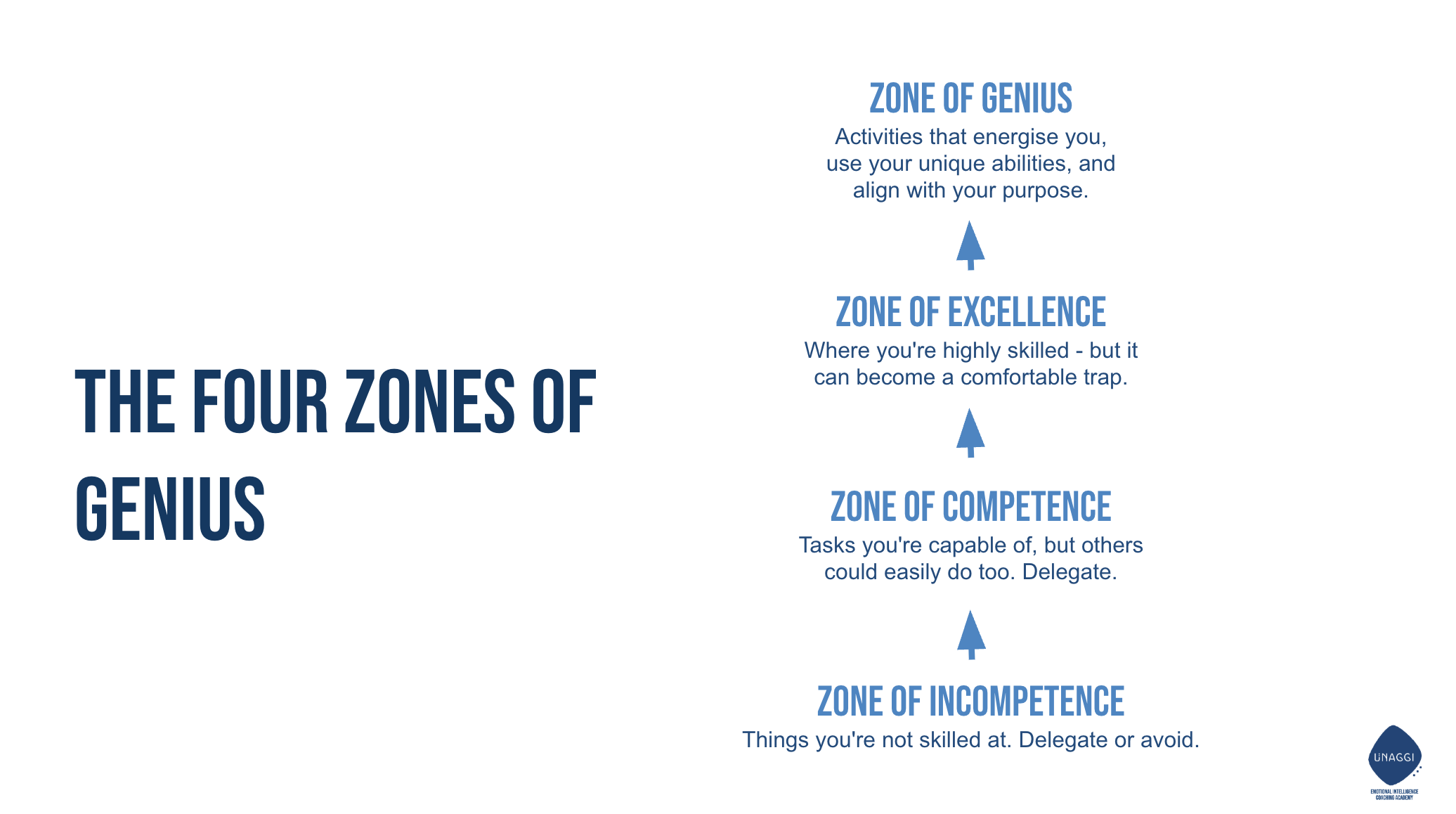
By contrast, many organisations rely heavily on the Zones of ‘Competence’ and ‘Excellence’ - (the two stages before we reach the Zone of Genius) rewarding competence and output while overlooking the emotional cost. Over time, this leads to disengagement, burnout and declining wellbeing, even among high performers.
Creating environments where individuals are supported to reach and work in their Zones of Genius is a way of addressing wellbeing at the root-cause.
Why wellbeing matters for sustainable performance
Teams with higher wellbeing consistently report greater optimism, engagement, and satisfaction at work. This matters because optimism shapes how challenge is perceived and responded to.
Growth, change, and innovation all involve discomfort - think of it like growing pains. Without wellbeing, that discomfort is easily interpreted as risk or failure, leading to resistance, avoidance, or burnout. Gay Hendrix calls this ‘upper limiting’ where you limit your growth because it feels uncomfortable, stopping your progression into the Zone of Genius.
When wellbeing is supported, individuals are more able to tolerate uncertainty and see pressure as part of progress rather than a signal to retreat. Their nervous system will be regulated enough to return to balance quickly after a growth phase and so challenges are met with excitement and positive energy. This creates momentum rather than stagnation.
Emotional Intelligence: the organisational shortcut to genius teams
The stability of workplace wellbeing is largely determined by emotional intelligence.
For wellbeing to be effective at an organisational level, it must feel dependable, not something that disappears during periods of pressure or change. This dependability is built through psychological safety, created from senior level, and through individual emotional resilience and optimism, both of which are emotional intelligence (EQ) skills.
Emotional intelligence in the workplace is about understanding and working with emotional experience so that it supports clear thinking, effective behaviour, and healthy relationships.
Several EQ skills have a direct impact on organisational wellbeing and performance, all of which are linked to an individual's experience of resilience and optimism:
Emotional self-awareness
The ability for individuals and leaders to recognise their own emotional responses. This reduces reactive behaviour and improves decision-making.
Flexibility
The capacity to adapt thinking, emotions, and behaviour in response to changing demands. Flexibility supports agility, innovation, and collaboration.
Stress tolerance
The ability to handle pressure without becoming overwhelmed. Strong stress tolerance supports clarity, composure, and consistent performance under load.
These skills are learnable. When developed across teams, they create a more resilient, adaptable and satisfactory organisational culture.
While lunchtime yoga and similar initiatives can help alleviate symptoms when workload outweighs resilience, they do not address the root cause. Embedding emotional intelligence within senior leadership teams and across organisational culture positively improves an employees experience whilst increasing resilience and reducing the load placed on their nervous systems.
By doing so, organisations move beyond symptom management to addressing the underlying conditions that create strain in the first place. This not only reduces the intensity of wellbeing challenges, but also lowers the likelihood of them emerging and persisting over time.
This functional, root-cause approach is the foundation of sustainable workplace wellbeing which improves the experience and abilities of everyone who experiences it.
Ready to Tune Your EI?
Let's find out how you can tap into your subconscious, primal drivers to make the shifts you need to get you from where you are now to where you want to be.
Or, join our mailing list!
And receive Unaggi Insights straight to your mailbox
We know what makes us feel good- and that is not SPAM. We will never sell your information, for any reason because we're here to make you feel good, too.